MenuClose
About
Mely Barragan
CHRIS KRAUS,
Writer & Filmaker
Mely Barragan, San Diego Art Prize 2023
Born in the mid-1970s, Mely Barragan is part of a dynamic cohort of contemporary Mexican artists who began their careers in the Baja California border cities of Tijuana and Mexicali in the 1990s. At that time, there were no formal art schools in northern Mexico. They learned by looking to the work of their predecessors, and to each other. Nevertheless, equally influenced by international contemporary art, Mexican and history and border culture, they chose to remain. As Barragan told Frieze magazine in 2019, “The outside world didn’t know what to make of us. We were neither Chicano or Mexican enough
Since her first exhibition, Mi Gente, in 2002, Barragan has worked across media – from collage and painting to sculpture and installation – to explore and enact urgent ideas. Like the late American artists David Wojnarowciz and Dash Snow, Barragan is a total artist, responding to the experiences she’s witnessed and passed through. She begins by selecting materials she believes will best describe her ideas, although often she finds that the materials take on a life of their own. The physical and internal dialogue with materials manifested in the four recent works in this show has become increasingly complex and devious over the years. The collages and paintings created in the series Mi Gente (2002) depicted the imaginary characters Barragan invented as a small child. Her earliest memories involved a search for identity and a desire for justice. In Los Guerreros (2006) she assembled a series of metal sculptures from roadside muffler shops: human figures welded from mufflers as DIY signage by the owner-mechanics. At the time, international curators were trawling Tijuana in search of the new, so Barragan decided to create an installation that captured the visual reality of this border mecca’s cheap auto repair and medical care. She thought – Why don’t I bring all the mufflers together? She named each piece for the mechanic who made it. The work brilliantly depicted the chaos and warmth of urban life. But Barragan’s work isn’t always created in Tijuana. Since the early 2000’s, she has traveled to residencies from Russia to China, to Morocco and the American midwest. Such residencies are essential to any contemporary artist living outside an international center. Like the equally nomadic, New Zealand-born sculptor Kate Newby, Barragan has accepted and capitalized upon this enforced nomadic state. She travels light, carrying only ideas, using the materials she finds in these strange new environments to bring them to life.
The sculptural works in this exhibition, all created in Barragan’s Tijuana studio during the past year, explore themes of personal and geopolitical history. Evading any easy description, they probe the undertow of psychic distress. In Family Legacy (2023), Barragan transforms her late grandfather’s old Bracero ID card into a magnificent banner or flag ringed by a fringe of chemical green. The ID card is a powerful totem, carrying both pride and shame. For twenty-two years, between 1942 and 1964, the Bracero program brought more than two million men to the US on short-term labor contracts and visas. The program defined a rich portion of Mexican cultural history that’s only recently begun to be rediscovered and claimed by projects like Ignacio Ornelas Rodriguez and Daniel Ruanova’s Bracero Legacy Project. To be a bracero was to become ‘one who swings his arms,’ working amidst toxic agricultural pesticides and hunched over all day with a short-handled hoe that ruins your back. The program also enabled her grandfather, Jose Barragan, to support his wife and twelve children in their home of Nuevo Ideal. “Among Mexican families,” Barragan recalls,
“it’s a stigma to have been a bracero. It was so delicate and hard to talk about.”
Over the years, Barragan came to realize that the Bracero program also helped to enforce a system of patriarchy, imposed upon families by historical circumstance and the culture itself. In Family Legacy, Barragan gently feminizes her grandfather’s experience, appropriating an heirloom that symbolized a man’s work and softening it with a granddaughter’s touch; sewing thread through the fabric that sustained her family. On the banner, Jose Barragan’s young face floats like a ghost. The card was issued to him by the US Department of Justice. By screen-printing the word ‘Justice’ in an almost imperceptibly bolder typeface, Barragan subtly, powerfully, evokes the unjust economic colonialism at the program’s heart.
Shallow Water Emerges Til Dawn (2023), a stunning and monstrous assemblage, hangs from the gallery ceiling by hooks and aluminum chains. Shiny black latex tubes, given weight by embedded chain, cascade to the gallery flood in a menacing flood. The piece is one of the most ambiguous, troubling works by the artist to date. In it, Barragan alludes to a time of chronic illness when she was forced to inhabit a medicalized version of her own life. But the trauma conveyed by the work extends far beyond her own body. Shallow Water evokes a larger, shared illness: a literal toxicity that spreads across landscape, affecting all human relations. The black latex shimmers seductively, weighted by chains. Bodies, the work implies, have become wholly disposable, like medical waste.
The work is a dream and a talisman for confronting fear. Installed alongside Shallow Water, Post Human Accumulations (2023) – four small- scale sculptures made out of electrical components, polyurethane foam, wood and glass – rest on the floor like small tumors. The sculptures are beautiful hazards, abstracting the biological waste and visual chaos across the US/Tijuana border into seductive and troubling form. ♦
Texto por Lucia Rey Orrego, 2022.
Texto por Lucia Rey Orrego, 2022. Académica e investigadora independiente (Chile).
Para la revista Arte Al Limite edición 101.
Mely Barragán
Blanduras, nudos y escrituras
Reflexiones estéticas performativas sobre la corporalidad de los significados
Un antecedente de lo que hoy se llama escultura blanda lo encontramos en los ready made de Duchamp, que empujaban al espectador hacia una crisis de significado y sentido material en relación a la funcionalidad de los objetos. Específicamente la funda hueca de una máquina de escribir con la inscripción en la misma funda de Underwood que titula Pliant de voyage, 1916. La propuesta de Mely se construye en su misma materialidad, la blandura de los objetos parecen indicar un vacío objetual. Estas esculturas blandas comienzan para la artista desde la experimentación con la escritura tridimensional ritual en 2008. Problematiza, no el acto de la escritura sino más bien la escritura como concepto, en donde el cuerpo de la letra se confunde con la abstracción, como un acto inasible. Así, esta escritura blanda va llenándose de contenido en la medida que se presenta en el ritual, como el llamado a la presencia física de lo que se escribe. Sin embargo, en este proceso de investigación, su propuesta adquiere un sentido crítico al encontrar disonancias entre la macro escritura objetual y los significados de las palabras. Allí es donde aparece la experimentación escultórica, puesto que emplaza perceptivamente al espectador a relacionarse con esta producción de sentidos, ya no de la escritura en sí directamente, sino con su presencia escultórica; le interesa a la artista “burlar los significados del lenguaje” en este tensionar significados a través de su puesta material en escena como nuevo contenido.
La cuestión contemporánea del arte conceptual, desde los años 60, ha problematizado el arte como objeto, para “instalar” el contenido como acción conceptual y fracturar la estabilidad y las estructuras materiales no solo del arte sino que también de realidades, en cuanto cultura. Así, las relaciones que se establecen a partir de la obra apuntarán a emplazar al público hacia una reflexión crítica sobre la propia realidad. En este caso, las 5 obras acá presentadas se modulan además por un proceso interior, de (auto)interrogación y (auto)transformación en relación a temáticas relacionadas principalmente con el tema del género y la apertura hacia una crítica femenina sobre la deconstrucción del masculino.
La primera obra es Behave, esta escultura indica al comportamiento como una cuestión cultural y biológicamente condicionada. En ese sentido la autora apela a la tensión entre la blandura de la escritura escultórica y el significado de la palabra. Una tensión que podría también aparecer entre la blandura de la carne uterina y la rigidez fálica de los significados, y también puede indicar supuestos determinismos del comportamiento humano, en tiempos en donde la ciencia parece imponerse desde las frías aguas del cálculo algorítmico. De manera que el estudio del comportamiento hoy en día se aloja muy específicamente allí, en los big data, con la inteligencia artificial. En este sentido nos podemos preguntar: ¿Qué significa comportarse? La artista abre la tensión en esta complejidad predecible de lo humano y la consciencia de nuestro propio comportamiento en el mundo, como decisión de lo que se es.
La elaboración material, que es central en su obra, indicará una intensión iconoclasta, pero no contra la imagen sino a través de ella, en este caso se trata de la cercanía entre las palabras y las cosas distanciadas en sus significados. La tensión conceptual entre: signo-significado-significante, en donde el significante es la letra, el signo es la obra, y el significado sería lo puesto en tensión (intersubjetiva) mediante la problemática material que constituiría una estructura de significados deconstruidos por los mismos materiales elegidos, que pretenden interrogar sobre lo escrito y su sentido en la realidad práctica. Esta tensión lingüística nos permite sospechar de alguna reminiscencia de culturas orales no alcanzadas por la modernidad, en donde elementos sígnicos pueden adquirir un valor simbólico primitivista.
La segunda obra se titula Acumulaciones, y corresponde a una articulación escultórica con objetos creados con la misma materialidad de la escritura, pero en este caso, no la usa para escribir sino para “dibujar” con volumen, estos volúmenes abstractos están cubiertos con pinturas y barniz, para generar una estética orgánica, como si se tratara de la exhibición objetual de interioridades arrancadas del cuerpo para ser colgadas ante el público, cuestión que nos sugiere la idea delueziana del cuerpo sin órganos, que Hal Foster apunta como un eje del arte contemporáneo.
La tercera obra se llama Bittersweet testosterone, es una obra con carácter intimista, con sentido terapéutico. La corbata, desde el siglo XVII existe como accesorio que da cuenta de un estatus especialmente masculino, en este caso podríamos verlos como signo del “privilegio masculino”, aunque también desde otra perspectiva, al sesgo puede observarse como un “corset” de ciertos tipos de palabras habladas (vinculadas a la blandura) y del oxígeno, con el que se puede también apuntar al “mandato masculino” que problematiza Rita Segato. En su doble significado: privilegio y a la vez mandato, lo que trabaja acá la artista es la masculinidad. La palabra escrita alude también a la palabra no hablada, anudada en la garganta, apuntando a lo no dicho, lo no tragado o procesado, dejándola en conexión con las obras anteriores. Esta colección de “sujeciones” o “privilegios” también sirven para colgarse desde el cuello. La artista logra abrir ese closet familiar desanudando las corbatas, mostrando en una superficie plana y curva, sin nudos, justo la parte que debe anudarse, exhibiendo una reflexión sobre la masculinidad.
La cuarta obra, Love handles, remite prontamente al cuerpo del erotismo femenino, que adquiere una forma contra-funcional, que aparece como anomalía enigmática, reapareciendo la idea deleuziana de la reorganización de los órganos a partir de los flujos deseantes. La quinta obra llamada Ovario 1, aunque aparentemente no hay indicios, nace de la palabra escultórica “macho”, que gracias a la blandura material, es moldeada al extremo hasta darle forma de útero. Este nudo blando, entonces sería el resultado de un ritual performativo intimista, que se presenta como un mundo-nudo interior femenino, que parece ser infinitamente curvo.
Estas cinco obras, aunque independientes unas de otras, forman parte de una proceso artístico introspectivo, cuya constante es la blandura y los nudos. La blandura puede llamar al relajamiento y al descanso, pero también puede generar nudos, para desarmar o para crear.
Trifecta: Art, Science, Patron
Trifecta: Art, Science, Patron
September 25, 2021 – January 16, 2022
Local artists and Salk Institute scientists collaborate in this interdisciplinary project that was inspired by the visionary gift of the Jacobs family. The Joan Klein and Irwin Mark Jacobs Senior Scientist Endowed Chair Challenge began in 2008 to encourage donors to establish endowed chairs in support of Salk scientists for their outstanding contributions to biological research. For every $2 million in donor contributions toward a chair, the Jacobs added $1 million to achieve the $3 million required for a full endowment. The Jacobs Challenge is responsible for 18 of the 31 chaired positions to date. The science that is funded today makes future discoveries possible and the patrons who make this research a reality are the stewards of tomorrow. To celebrate this gift to posterity, local artists have been paired with many of these honored scientists to create this exhibition. Through their artwork, the artists share their visions inspired by this cutting-edge research funded by philanthropic patrons of the community. This trifecta of artist, scientist, and patron pays homage to major contributors of this vibrant community and inspires a better future.
Featured artists include: Marcos Ramirez ERRE, the De La Torre Brothers, Siobhan Arnold, David Adey, Xuchi Naungayan Eggleton, Debby and Larry Kline, Mely Barragan, Christopher Puzio, Cesar and Lois Collective and Wendy Maruyama.
Curated by Chi Essary
Major funding for this project generously provided by the Ray Thomas Edwards Foundation with additional support from Weston Anson and ArtWorks San Diego. Institutional support provided by the City of San Diego Commission for Arts and Culture and by the Members of the La Jolla Historical Society. The Society is immensely grateful to the Salk Institute for Biological Studies for their support and participation in this project.
Grabs Back @ Being Here With You / Estando Aquí contigo
Grabs Back @ Being Here With You / Estando Aquí contigo – MCASD Museum Of Contemporary Art San Diego 2019
Mely Barragán highlights daily life and popular cultures sites of contradiction in patriarchal and consumerist society. Often working with found images and materials that carry gendered associations, Barragan multiplies signifiers of femininity to scramble stereotypes.
Barragán´s Grabs Back is more pointed in its subject, offering a response to U.S. President Donald Trump´s boasting of sexual assault on the notorious ¨Access Hollywood¨ tape. The word ¨pussy¨ is surrounded by a bustling arrangement of vintage illustrations – of men, women, and a large poodle- and layered with sequins, fur, a skirt, and painted phallic forms. Additional textual elements – ¨female dog¨, and ¨grabs back¨ – propose an active mode of resistance to forms of indignity and oppression endorsed by those with power.
(excerpt from Museum catalogue)
Mixed media, painting on tapestry cloth, thread, hairy texture, sequins, on stretcher. size 164 X 194 cm.
///////
técnica mixta, pintura sobre tela de tapicería, hilos, peluche, acrílico, lentejuela sobre bastidor. dimensiones 164 X 194 cm. año 2017.
BEING HERE WITH YOU/ ESTANDO AQUÍ CONTIGO: 42 ARTISTS FROM SAN DIEGO AND TIJUANA
BEING HERE WITH YOU/ ESTANDO AQUÍ CONTIGO: 42 ARTISTS FROM SAN DIEGO AND TIJUANA
Thursday, Sep 20, 2018 to Sunday, Feb 03, 2019
Being Here with You/ Estando aquí contigo brings together work by 42 artists and collectives living and working in the San Diego and Tijuana region. Presenting both early career and established artists, Being Here with You/ Estando aquí contigo highlights distinctive practices shaping conversations and communities in our binational region and beyond.
Being Here with You/ Estando aquí contigo borrows its title from the bilingual song “Angel Baby” by Rosie and the Originals, a teenage band from National City, California, which points to the region’s rich history of homegrown talent. The title also harkens back to MCASD’s 1985 survey, A San Diego Exhibition: Forty-Two Emerging Artists. Since that time, MCASD has broadened its focus to include the work of Tijuana artists. Being Here with You/ Estando aquí contigo reflects the Museum’s mandate to serve the binational constituency of the region and affirms its commitment to artists on both sides of the border. Recognizing that San Diego and Tijuana’s artistic communities are distinct but overlapping, the exhibition builds on the ongoing artistic exchanges between the two cities.
Being Here with You/ Estando aquí contigo presents artworks in a broad range of mediums, including installation, painting, drawing, video, digital media, photography, sculpture, ceramics, textiles, and performance. The exhibition draws attention to common interests and artistic strategies. Artists in the exhibition address today’s urgent questions as well as issues affecting our region, including public space and public memory; colonialism and its afterlife; the border as fantasy and reality; housing and homelessness; feminist and queer politics; and the place of the body in the digital world.
An improvisational approach to process and performance is shared by numerous artists, many of whom engage in painterly experimentation and the transformation of traditional craft forms. Many artists demonstrate a resourcefulness with respect to materials, especially through the reclamation and reanimation of found objects. Collaboration is a frequent strategy, with several artists working directly with their peers or alongside members of their communities. Being Here with You/ Estando aquí contigo also acknowledges the crucial role that alternative art venues play in the region’s art scene, with nearly a quarter of the exhibition’s artists running or programming independent spaces in San Diego and Tijuana.
MCASD is honored to include the work of James Luna (1950-2018), who accepted our invitation to participate before his untimely passing. For over four decades, Luna subverted accepted narratives of history and cultural identity through his incisive, humorous, and often poignant installations and performances. His influence is apparent in the work of many artists in Being Here with You/ Estando aquí contigo.
Being Here with You/ Estando aquí contigo is co-organized by Curator Jill Dawsey and Assistant Curator Anthony Graham. The exhibition will be accompanied by an illustrated catalogue.
Being Here with You/ Estando aquí contigo: 42 Artists from San Diego and Tijuana is organized by the Museum of Contemporary Art San Diego and made possible by the Being Here With You/ Estando aquí contigo: Underwriters Community. Institutional support of MCASD is provided by the City of San Diego Commission for Arts and Culture and the County of San Diego Community Enhancement Fund.
ASSEMBLING DEEP BLUNT THOUGHTS
ASSEMBLING DEEP BLUNT THOUGHTS
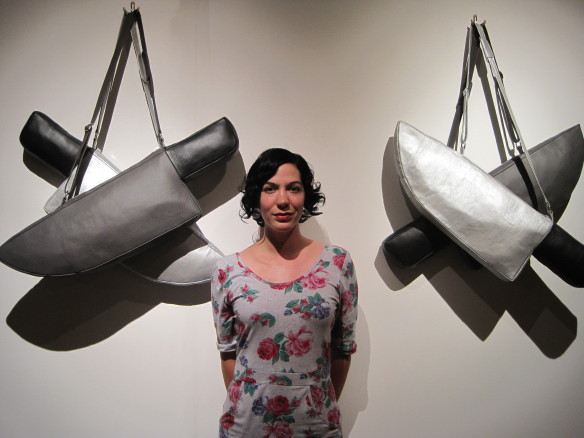
Si las palabras son cuchillos, la obra de Mely Barragán (Tijuana, 1975), llena de palabras y cuchillos en igual cantidad, se descubre obsesiva en su intento por decirnos algo. Utilizando elementos gráficos e imágenes reapropiadas de medios masivos y cultura popular, Barragán aborda temas como la desigualdad de género y violencia normalizada en cada detalle de nuestras vidas. Esta selección de obras es tan sólo una muestra de la trayectoria de la artista durante los últimos años y de su proceso creativo, el cual se sigue desarrollando como un ensamblaje de sus pensamientos más profundos y afilados.
El título de la exposición es un ejemplo de la manera aguda en la que Barragán juega con las palabras, partiendo por la traducción como arma de doble filo: simultáneamente es herramienta y obstáculo. Por ejemplo, la palabra blunt significa ¨desafilado¨ (como un cuchillo sin filo) y también puede ser algo o alguien ¨directo¨,¨franco¨,¨cortante¨ o ¨descortés¨. Barragán a menudo usa el bilingüismo como estrategia y combina elementos gráficos absurdos y disonantes. Mientras que en Haunted (2014-2015) un felino que observa la composición puede ser a la vez cazador y presa, Literatura (2017) es un políptico que yuxtapone frases en blanco y negro para hacer una lectura crítica de la ¨literatura basura¨, jugando con la traducción convirtiendo la primera parte en litter, o basura. De las frases resalta por ejemplo ¨Gunn Laws¨, pues esta se lee como ¨reglamentos de armas¨pero originalmente hace alusión al famoso profesor de moda y conductor de televisión Tim Gunn.
Este frenesi de palabras en sus collages más recientes tiene el mismo efecto cuando la artista usa palabras en singular y las vuelve tridimensionales. Macho (2009) pone en evidencia las contradicciones de la masculinidad exagerada con la selección del material y de la letra cursiva, ambas asociadas con cualidades femeninas. Otra escultura blanda que sirve como puente para tejer la relación entre las obras es Shallow Water II (2012). Está plantea el tema de la violencia mediante la materialidad del vinilo, el cual tiene connotaciones sexualizadas, pero cuyo título también insinúa el peligro del océano en zonas donde el oleaje no se rompe y nuestra vulnerabilidad en situaciones que superficialmente parecen ser inofensivas.
Finalmente, con Hard and Soft Knives (2015-2016), Barragán pone en tensión a los materiales y a nociones de domesticidad y protección. Así como es un arma de agresión o resguardo, el cuchillo como objeto ha sido empleado como recurso visual por artistas feministas desde los años setenta. De igual manera, Barragán subvierte la forma directa de los significados del lenguaje que nos oprimen y reprimen para cambiar su sentido y destruir arquetipos por medio de la imagen y la palabra.
Selene Preciado, marzo 2017